
For the end of my degree alongside my exhibition I wrote an essay about my work, the research, inspiration and method behind everything that led up to how and why I created the pieces I did. I thought I would share this on here as I am proud of my writing and hope that it could in turn inspire someone else.
Abstract
Familiar faces is an exploration of the creation of identity through portraiture. The project demonstrates how the face tells a visual story which provokes emotions and remembrances of experiences and memories through its intimacy. Thus, certain faces become familiar throughout the progression of a person’s life due to shared experiences. These portraits were created with this idea in mind – to explore the development of my identity through family members and close friends.
Using and developing the process of lithography accompanied by the influence of nineteenth-century portraiture and the use of symbolism within artwork, including Aboriginal contemporary works, this investigation explores, not just a sense of identity in oneself through familiar faces but also the identity, qualities, and auras of the people themselves. Each portrait reflects the intent of resonating identity in its symbolic nature and the influence of people upon a person’s identity (using myself as the primary subject) and how it changes. The portraits, as a whole, are a symbol of my life story and how every individual included in this body of work contributed to forming my identity through our shared experiences. Each subject’s own identity and qualities are interwoven into the storyline of each print and each stage of my life as which they have been present for the changes, growth and experiences. These familiar faces are key to the journey of sense of self and make-up of identity which was explored in the creation of the work and is explored in this paper.
Introduction
Familiar Faces – throughout our lives there are people who contribute to our sense of identity. Shared experiences, and therefore memories intertwine people as they become familiar to each other. Through drawing portraits of the familiar faces who have shared my own life, parents, family members and close friends, it has enabled an exploration of sense of self and identity over this past year.
Influences, such as lithographic portraits of the nineteenth century and the use of symbols in contemporary Aboriginal paintings, came together to enable works that demonstrate a combined state of composed and expressive natures. The portraits created, using lithography as a printing technique, express not only a sense of self, but also of the people themselves as individuals, each with different auras and identities that have impacted on my life.
This essay will discuss and reflect on the journey taken this year, exploring the development in the technique of drawing the portraits, the actualisation of the subject’s symbolic natures, a growing awareness of self-identity, process and intent which led to the final portraits.
Chapter one – Studio Work; process and development over the year
Early work
The start of third year begun in early October last year, and upon the first day in the studio I was asked what my focus would be for the next year, my spontaneous reply was portraits. But why portraits? I have always been drawn to creating and viewing portraiture in all mediums because of the many visual stories the human face tells, so many emotions and memories to relive in each one. But what had become clearer over the last two years is how central familiar faces are to our sense of belonging and identity. From leaving home to go to university and then the lockdowns that took place, that we all as a world experienced, what I missed most in these circumstances – and what others can also attest to – was the comfort from the familiar faces you had become accustomed to seeing every day and experiencing life with. Portraiture was a way to explore the stories, the missing and the identity – mine and my subjects.
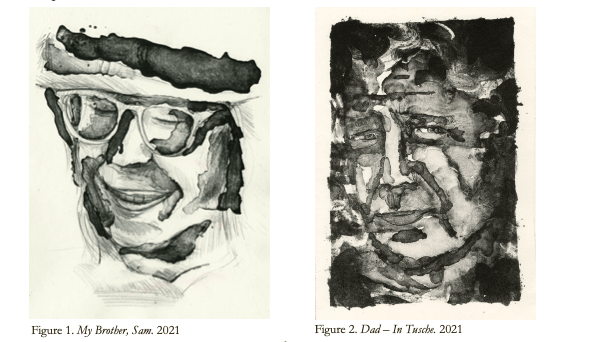
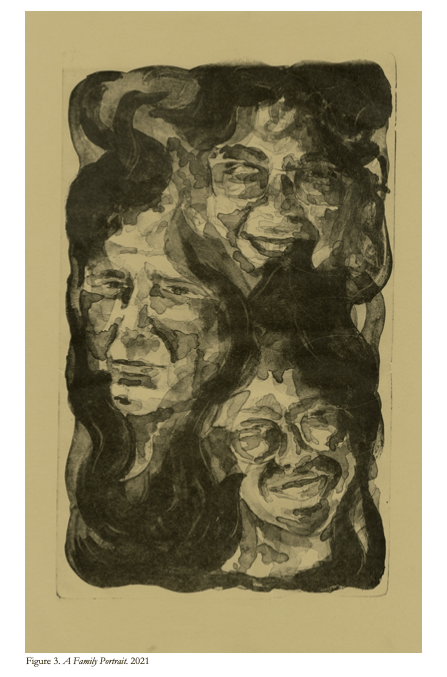
From these initial thoughts it was clear that creating this series of portraits was a way to express something that is integral to my life and identity. An obvious place to start was to draw my family who are at the core of my identity, the people who helped form who I am. I began my journey with portraits of my brother and my father (fig. 1 & fig. 2). This work was experimental as a way to come to grips with drawing on a lithographic stone and to explore lithographic different drawing mediums. The aim was to create an image that was a projection of a memory, capturing that person in a particular moment of time in which I have known them. This was achieved through the loose linear qualities of the portraits and the use of tusche to create a haziness surrounding the face, as if it was appearing from a past memory. Finding that I enjoyed the hazy quality of fig. 2, I followed this with A Family Portrait (fig. 3) of my mother, father, and brother, attempting to depict the trio as figures emerging from a memory. Unfortunately, the stone had scratches on it, which were very prominent after printing making it unsuitable as a finished print.
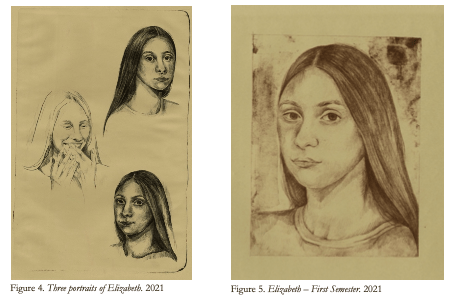
At this stage, it was halfway through the semester, and with a developing interest in the techniques and composition of nineteenth-century portraiture, I came to realise the work was not heading in a direction that would facilitate the aim of expressing these people and my own identity effectively. In the past I had always drawn portraits in the style of realism which promoted a newfound interest in nineteenth-century portraiture and its techniques. The research of this style of portraiture took the work took to a new direction. Fig .4 and fig. 5 were drawn from photographs of my friend Beth, and they focused on the drawn quality within the images by exploring the drawing techniques and composition of portraiture, removing the distraction of the haziness. These portraits formed a base to develop the work for the final exhibition pieces, to start forming more connections with the portraits, and in turn to further the exploration with my sense of self.
Development of subject matter, technique and process using lithography
Before the second year at university, I had not even heard about lithography – or many other printmaking methods for that matter. However, what I did know was that I loved drawing. Once I decided that I wanted to pursue drawing in my degree, it was recommended to try lithography as a process that uses drawing. What I did not expect was that it would become my process of choice for my third-year project. Lithography provided an opportunity to draw in a way that no other process could.
The development of the technique and process using lithography has been a gradual one over the course of the year. The study of the work of other artists, the development of technical skills, and the use of the lithographic drawing has been crucial in the process of drawing on the stone. In my earlier works, I experimented with using a tusche wash (fig. 1, 2 and 3) which created
very loose expressional marks/areas of tone. However, as the direction of my portrait works changed and through wanting to create tighter, more realistic portraits, I experimented with different lithographic crayons. It took a while to become accustomed to drawing with the crayons as they are a lot thicker than most pencils and therefore, it is difficult to get very fine linear qualities in the drawing. But after the earlier experimentations, I was able to achieve these qualities through the use of a Korn crayon in copal 5, which is the hardest Korn crayon available. This enabled me to do what I wanted to achieve with lithography.
The first portrait drawn with the No. 5 crayon (fig. 6), was drawn on the biggest stone I had used thus far and as a result the portrait could breathe, and I could create marks freely. By always keeping my crayon sharpened with a razor I was able to create very fine hatched lines, exhibiting tone and emphasising features that needed highlighting. The creation of areas of light to contrast with the dark was important to these portraits and so I used the blank canvas of the stone to its advantage. The areas of highlight that I left with none, or very minimal marks became prominent when printed. Another decision to be made was which colour to print them in. When printed in black they felt impersonal and didn’t express the emotive aura I wanted to project. Therefore, I experimented with mixing shades of sepia– a colour of which is a reminiscent of old family photographs. This colour softened the portraits (fig. 6 and fig. 7) and brought out the sense of familiarity I had been seeking. To further this idea the selection of the tan shade of paper accents the intentions of its appearance and corresponds cohesively with the sepia ink.
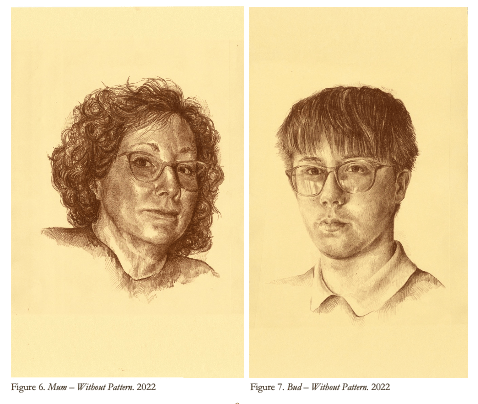
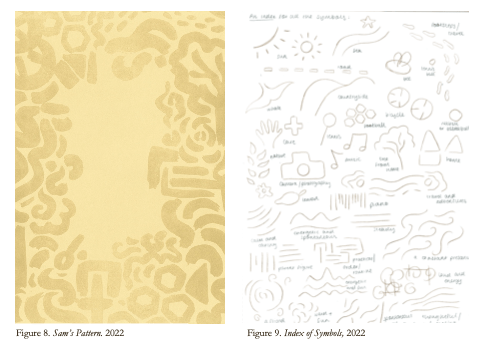
Over the year the development of subject matter (being portraits) progressed and moulded into not only an exploration of self-identity but also of the people themselves as individuals, with their own identities and auras. These works explored the subject’s aura as ‘a feeling or character that a person… seems to have’ (Cambridge) through encompassing the qualities that emanate from each person. After drawing the portraits of my mother and brother (fig. 6 and 7), it became apparent that they needed something that would enable the viewer to discover a small part of the subject’s identity that I was wanting to highlight. To do this I began experimenting with the idea of using a series of marks and symbols as a background around the portrait, creating my own index of symbols which portray both the emotional and physical attributes (fig. 9) of each person. Through experimenting with different techniques of using lithographic ink on stone, I painted the symbols onto the stone with relaxed, broad strokes using lithographic ink, which is a thick paste that when painted onto stone creates complete solid lines/shapes when printed. When printing these on top of the portraits, I thought they should be a brown or blue coloured ink, however, upon printing I found that the solid colour took too much attention away from the portrait. Therefore, by mixing extender (which is a transparent ink) with a slight tint of brown and blue which, when printed, created a translucent print (fig. 8). This is exactly what I wanted, as the patterns came through strong enough for the viewer to see the symbols, but the portraits remain the focal point.
The combination of the highly realistic portraits with the loosely drawn symbols, allowed my work to progress steadily from an initial idea of portraiture into a project exploring the self, an attempt to capture each person’s identity through the lithographic processes and techniques that I learned and developed throughout the course of the year.
Chapter two – Research and influences
Playing a significant role in my art practice have been a few artists and influences who have helped shape and contribute to the drawing of my portraits and the actualisation of the symbolic elements in the works.
Influences on my portraits
As I have researched and explored, my portrait work has developed and grown throughout the year. Artists such as Gerhard Richter, Jono Dry, M. C. Escher and Francis Earnest Jackson were my initial sources of influence. But lithographs and portraits of the nineteenth century, particularly by artists Eugene Delacroix, Théodore Gericault, Alexandre Marie Colin, and Achille Devéria, became the main source of inspiration, for both style and technique.
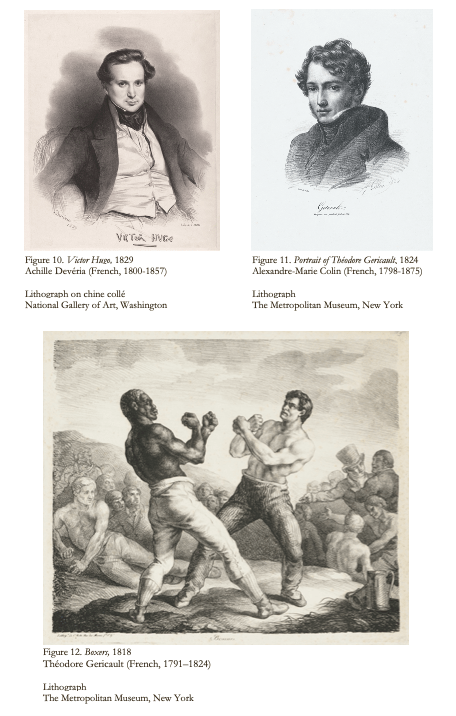
In the early nineteenth century, lithography, specifically in Paris, was growing in popularity and young artists were exploring and expanding the realm of lithography’s potential. By looking at the portraits created during this time, I was able to learn from their processes and techniques – Gericault’s use of hatched lines in varying ways and strong confident strokes are a simple but effective way of creating depth and contrasting areas of dark and light (fig. 12). Similarly in the prints created by Devéria and Colin (fig. 10 and 11), the mark-making is sensitive, tight in areas of focus (the face) and looser towards the bottom of the bust. As well as learning from their processes, I wanted my portraits to have a deliberate composure similar to these nineteenth-century portraits, to draw them as if they were old family portraits drawn in that era. However, many of the portraits in the nineteenth century were focused on portraits of ‘prominent individuals’ of ‘fame or notoriety’ (Giviskos, 54), an example of this is Devéria’s lithograph portrait in fig. 10 which depicts Victor Hugo, a rising novelist. The portraits were to be different from these lithographs, not celebrating fame but celebrating the familiar, the people of notoriety in my life, the people who are a part of my identity. Similar to this were the conceptual ideas behind the work of Shani Rhys James (fig. 13), whose work demonstrates the intensity of the connection of people with identity and self. Her imagery is ‘intensely personal’, rooted in exploring ideas of heritage and a ‘fierce undistracted concentration on the artist’s self’ (Green). With her paintings depicting settings of family and studio, she has been able to locate her sense of self within these contexts, exploring memories and emotional bonds, constantly asking the question of who she is with her bold, vivid paintings, which are ‘conveyed with power’ (Lord, 387). I wanted my work to achieve similar aims.
Studying these linear qualities and conceptual ideas from these artists allowed me to implement such strengths in the representation of my subjects. By thinking about the impression the portrait gives to the viewer, I found a way to express this powerful feeling of identity and self through my portraits and while expressing the personality of the subject.

Influences on the background and work with identity
Certain artists and artforms provided understanding of what it means to explore identity and how symbols can tell a story through your artwork. When beginning to think about the use of symbols as a way to express the subject’s personality, I looked to work that used symbols, for example, contemporary Australian Aboriginal art. The use of symbols within Aboriginal art are a visual language used to communicate information; they tell a story or share knowledge to others about land, history, or identity (Owen). They are, however, not an exact record, they use the concept of the Dreaming in much of their artwork which is ‘a uniquely Aboriginal way of placing people in time and space, it forces one to think differently and in a less linear way’ (Morphy, 4). It allows the symbolic nature to speak for itself in the paintings rather than depict an exact outline. This is achieved through separate symbols, each developing and becoming a new meaning when combined, similar to how different combinations of words can change a story. The symbols are ‘systems of representation [which] are often employed in combination, one amplifying the meaning of the other’ (Morphy, 113). Within my own work I focused on these ideas, coming up with my own system of symbols, marks, and patterns to depict the story and journey of each person in my portraits.
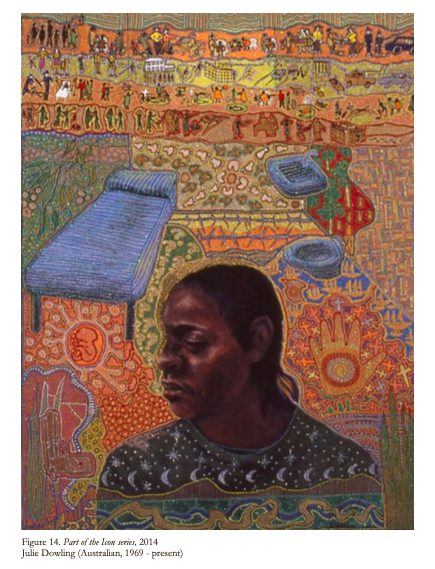
Australian Aboriginal artist, Julie Dowling was another influential figure in strengthening my concept on identity and the importance of such in my work. Dowling believes that it is important to her to capture; ‘The very essence of the subjects being” (Art & Australia), a concept with which I have been striving for this year through my exploration of self. Dowling’s realistically painted portraits, like that of fig. 14, have a hyper fixation on identity and cultural roots in its symbolic, personal nature, which allows the portraits to speak of their own identities and stories. The way she develops the theme of identity so strongly in her artwork has influenced and shaped my own conceptual basis and use of symbols.
Chapter three – My Familiar Faces; What do these portraits mean to me?
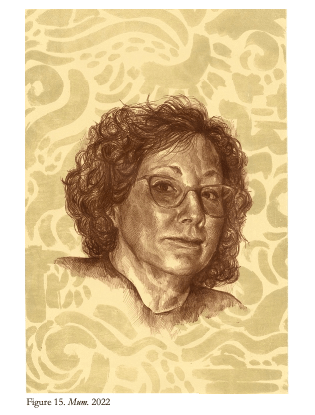
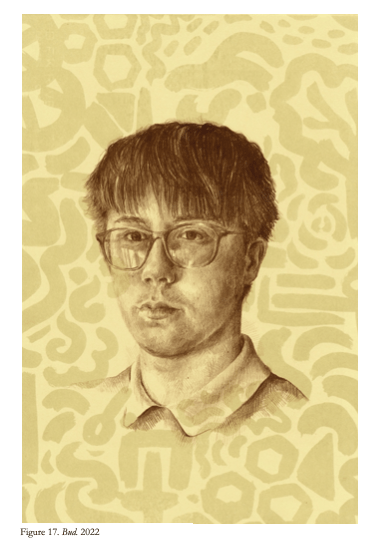
The development of process and technique, the influence of the artist research and the intent to explore the self in both my own identity and the identity of the subject with portraiture this semester has cumulated in a series of seven portraits and four additional portraits to exhibit. Every portrait aims to portray the person and to reflect our shared experiences that exist, familiar, in my memory. My closest family are depicted, with my mother in fig. 15, my father in fig. 16 and my brother in fig. 17. My mother and father are the closest people to me, they have supported me through each stage of my life and have been a constant presence. The portraits represent them as people who have shaped me to be the person I am and allowed me to choose how to be that person. When drawing their symbols, it really made me realise how in the representation of their identity’s, interests, and auras I could see how my own are interwoven in them, with similar interests and qualities from each person. My brother, Sam, depicted in fig. 17, is my only sibling and thus, we spent most of our time together as children and I call him a very close friend as well as a sibling. Growing up without him would have made me a very different person, as through our shared lives and experiences, our identities have been shaped and influenced by each other, every step of the way. He is someone that will always be a part of who I am as a person.

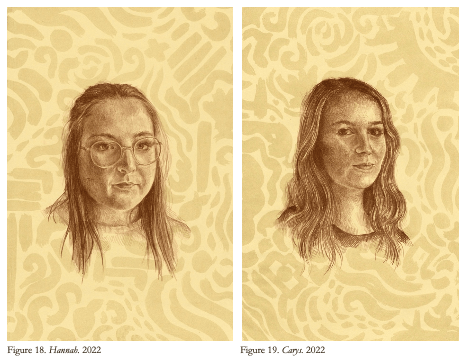
As well as family members I selected other people in my life who, with their inclusion in this project, represent the familiar and contribute to my identity. First is my closest friend Hannah (fig. 18), who I met at the start of secondary school. We have been close friends from the age of thirteen and have gone through many major similar periods of change. We have travelled together and shared hobbies and interests. Her constant presence, support and our shared history has interwoven her into my identity and experiences. She is a key part of who I am as a person, as am I to how she has developed as a person within our respective individual nature.
A substantial change in my life was moving to university, which was a daunting prospect. It meant moving to a place in where the faces you have grown up with and are familiar are no longer a part of your daily life. However, three years later I can look back on my time here and recognise three familiar faces who have become an integral part of my life and identity. I met Carys (fig. 19), Elizabeth (fig. 20) and Ameesha (fig. 21), on the first day of university, when moving into a flat where we had all been randomly thrown together. It was unexpected how influential they would be to my growth during university. Living together meant we shared many memories and experiences, which have caused us to learn and grow as people together. Through the ease and familiarity of our friendship, they have all in different ways, influenced me to become a much more confident version of myself, to push myself to learn and to think more deeply about who I want to be as a person, who I identify as. Overall, as I have grown as a person into adulthood, my sense of self and identity, along with theirs, has been directly influenced and shaped by our shared lives these last three years, becoming familiar faces in a once unfamiliar place.
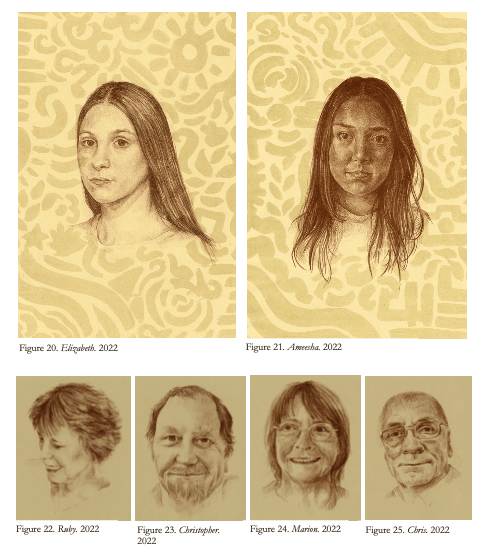
Alongside my exploration of these people who are direct influences upon my identity, I also explored the indirect influence of the older generation in my family, looking at people, with whom, I had limited contact with whilst growing up. The learning of their identity and nature came through the stories being told to me. Their influence has been passed down to me through their influence upon my parent’s identity, such as my mother’s father’s love of photography. My mother developed her love for photography from her father and in turn, she passed this love down to me. I now use his old film camera and thus, my interest was indirectly influenced by him. In this additional series, I have included my mother’s mother (fig. 24) and her late father (fig. 23), as well as my mother’s stepfather (fig. 25) and my father’s mother (fig. 22). By intentionally drawing these portraits smaller, they are, as if, smaller fragments of influence upon my identity, a distant memory. These portraits are without a symbolic background as their auras and qualities are not as familiar to me, so my representation of their identity cannot be as substantial. However, drawing these portraits provided a way to get to know my grandparents on a more familiar level, especially my late grandfather, of whom drawing was an exploration of getting to know a face that should have been a familiar influence in my life. This provided an opportunity to learn how they influenced my parent’s identities and thus, in turn, my own.
Chapter four – Reflection and Conclusion
Thoughts and feelings while drawing the portraits – a reflection on my exploration with self-identity.
Throughout the process of drawing these portraits there have been several moments of complete self-awareness and contemplation, I would find myself really understanding who I was drawing and what they mean to me. These movements would bring on a tide of sentimentality and memories, as well as a realisation that these people are a part of my identity and that I would not be who I am and how I experience life as I do without them.
With the portraits completed and seeing all the closest people in my life together, it is like reading a book of my life, every character traced in a chapter, present for each plot twist and experience. I hope the viewer, who will not be familiar with the faces will be able to form a connection through the sense of familiarity and emotion that I have portrayed. The tracing of each face and symbol provides a journey that ventures through the make-up of my identity and represents the aura and identity of the subject as well.
Conclusion
Three years of art practice at Aberystwyth University has provided the opportunity to develop new knowledge and ability within the realms of printmaking, accumulating to this resulting project. The work has evolved and formed throughout the year, delving into an exploration of sense of self, identity, and symbolic natures.
Completing the portraits through lithography fulfilled the aim to explore how shared experiences and memories intertwine people and lives, creating a familiarity which becomes a part of the being’s identity. Furthermore, each individual can express a variety of different auras and qualities which impact identity and relationships. Overall, the familiar face is a powerful force, it can stop you in your place with an overwhelming number of memories and a sense of stability in its familiarity. I am looking forward to progressing with this concept and developing the lithographic processes, a technique that I have enjoyed working with this year, in my art practice beyond university.
Undoubtedly this project has brought me closer to the centre of my being, by developing an understanding of what makes, and shapes life, identity, and sense of self through exploring the numerous memories, moments, and experiences you make with the familiar faces in your story of life.
Bibliography
“Aboriginal Art Symbols – Iconography | Kate Owen Gallery”. Kate Owen Gallery, https://www.kateowengallery.com/page/Aboriginal-Art-Symbols. Accessed 16 April. 2022.
Art & Australia. Current: Contemporary Art from Australia and New Zealand. Dott Publishing, 2008.
“Aura.” Cambridge Dictionary, https://dictionary.cambridge.org/dictionary/english/aura. Accessed 1 May. 2022.
Giviskos, Christine. Set in Stone: Lithography in Paris, 1815-1900. Hirmer, 2018.
Green, Andrew “Shani Rhys James.”Gwallter. 2015, https://gwallter.com/art/shani-rhys-james.html. Accessed 20 April. 2022
Lord, Peter. The Tradition: A New History of Welsh Art. Parthian Books, 2016.
Morphy, Howard. Aboriginal Art. Phaidon, 1998.
 ellagurrart.co.uk
Leave a comment